Showing:

Annotations
Attributes
Diagrams
Facets
Model
Properties
Source
Used by
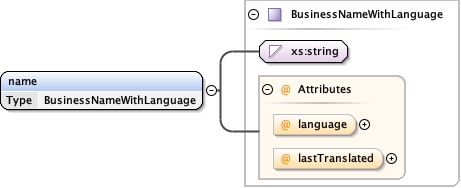
Element DataSetConceptListConcept / name
Namespace No namespace
Diagram
DiagramDECOR-datatypes_xsd_Complex_Type_BusinessNameWithLanguage.tmp#BusinessNameWithLanguage_languageDECOR-datatypes_xsd_Complex_Type_BusinessNameWithLanguage.tmp#BusinessNameWithLanguage_lastTranslatedDECOR-datatypes_xsd_Complex_Type_BusinessNameWithLanguage.tmp#BusinessNameWithLanguage
Type BusinessNameWithLanguage
Properties
content complex
minOccurs 1
maxOccurs unbounded
mixed true
Attributes
QName Type Default Use Annotation
language LanguageCode en-US optional
Indicates the language in which the business name is expressed
UML: Part of a complex tag value
DublinCore: Language
Alpha
lastTranslated TimeStampNoTimezone optional
Indicates when this languages rendition was last translated from the original.
UML: part of a complex stereotype tag
Source
<xs:element name="name" type="BusinessNameWithLanguage" minOccurs="1" maxOccurs="unbounded"/>
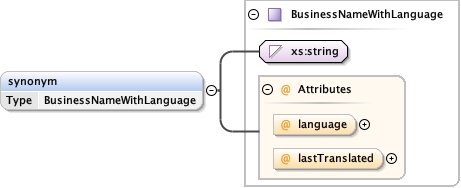
Element DataSetConceptListConcept / synonym
Namespace No namespace
Annotations
Synonym for a Data Set Concept List Item Name (short). Can have multiple synonyms per language.
Diagram
DiagramDECOR-datatypes_xsd_Complex_Type_BusinessNameWithLanguage.tmp#BusinessNameWithLanguage_languageDECOR-datatypes_xsd_Complex_Type_BusinessNameWithLanguage.tmp#BusinessNameWithLanguage_lastTranslatedDECOR-datatypes_xsd_Complex_Type_BusinessNameWithLanguage.tmp#BusinessNameWithLanguage
Type BusinessNameWithLanguage
Properties
content complex
minOccurs 0
maxOccurs unbounded
mixed true
Attributes
QName Type Default Use Annotation
language LanguageCode en-US optional
Indicates the language in which the business name is expressed
UML: Part of a complex tag value
DublinCore: Language
Alpha
lastTranslated TimeStampNoTimezone optional
Indicates when this languages rendition was last translated from the original.
UML: part of a complex stereotype tag
Source
<xs:element name="synonym" type="BusinessNameWithLanguage" minOccurs="0" maxOccurs="unbounded">
  <xs:annotation>
    <xs:documentation xml:lang="en-US">Synonym for a Data Set Concept List Item Name (short). Can have multiple synonyms per language.</xs:documentation>
  </xs:annotation>
</xs:element>
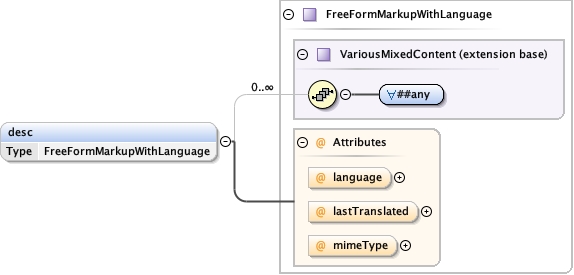
Element DataSetConceptListConcept / desc
Namespace No namespace
Diagram
DiagramDECOR-datatypes_xsd_Complex_Type_VariousMixedContent.tmp#VariousMixedContentDECOR-datatypes_xsd_Complex_Type_FreeFormMarkupWithLanguage.tmp#FreeFormMarkupWithLanguage_languageDECOR-datatypes_xsd_Complex_Type_FreeFormMarkupWithLanguage.tmp#FreeFormMarkupWithLanguage_lastTranslatedDECOR-datatypes_xsd_Complex_Type_FreeFormMarkupWithLanguage.tmp#FreeFormMarkupWithLanguage_mimeTypeDECOR-datatypes_xsd_Complex_Type_FreeFormMarkupWithLanguage.tmp#FreeFormMarkupWithLanguage
Type FreeFormMarkupWithLanguage
Type hierarchy
Properties
content complex
minOccurs 0
maxOccurs unbounded
mixed true
Model
ANY element from ANY namespace
Attributes
QName Type Use Annotation
language LanguageCode optional
Indicates the language in which the marked up text is expressed
UML: part of a complex stereotype tag
lastTranslated TimeStampNoTimezone optional
Indicates when this languages rendition was last translated from the original.
UML: part of a complex stereotype tag
mimeType MimeType optional
Indicates the mime type in which the data is expressed. If not specified, applications SHALL interpret the content based on other context or
specific application rules. Applications that do not recognize content SHALL retain it unchanged.
UML: Part of a complex tag
Source
<xs:element name="desc" type="FreeFormMarkupWithLanguage" minOccurs="0" maxOccurs="unbounded"/>
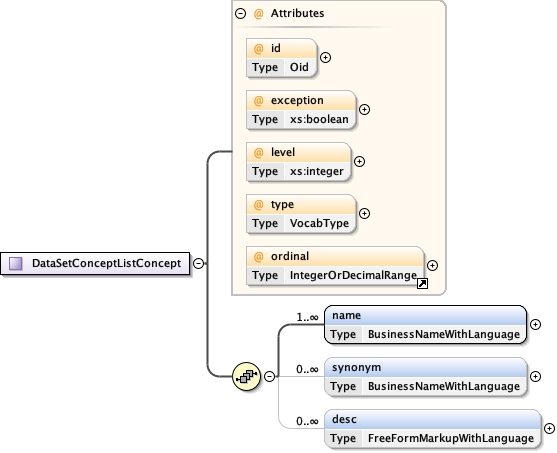
Complex Type DataSetConceptListConcept
Namespace No namespace
Diagram
DiagramDECOR_xsd_Complex_Type_DataSetConceptListConcept.tmp#DataSetConceptListConcept_idDECOR_xsd_Complex_Type_DataSetConceptListConcept.tmp#DataSetConceptListConcept_exceptionDECOR_xsd_Complex_Type_DataSetConceptListConcept.tmp#DataSetConceptListConcept_levelDECOR_xsd_Complex_Type_DataSetConceptListConcept.tmp#DataSetConceptListConcept_typeDECOR_xsd_Attribute_ordinal.tmp#ordinalDECOR_xsd_Complex_Type_DataSetConceptListConcept.tmp#DataSetConceptListConcept_nameDECOR_xsd_Complex_Type_DataSetConceptListConcept.tmp#DataSetConceptListConcept_synonymDECOR_xsd_Complex_Type_DataSetConceptListConcept.tmp#DataSetConceptListConcept_desc
Used by
Model
Children desc, name, synonym
Attributes
QName Type Use Annotation
exception xs:boolean optional
indicates whether this is an exceptional concept (for example: unknown)
id Oid optional
level xs:integer optional
ordinal IntegerOrDecimalRange optional
Relevant score value in an ordinal system, usually/preferably coded but ordinal values are known to exist with just a description. Coded examples include Apgar and Glasgow Coma Scale. An, at time of writing, uncoded example is the questionnaire "Positieve Gezondheid" (https://nl.wikipedia.org/wiki/Positieve_gezondheid)
type VocabType optional
Source
<xs:complexType name="DataSetConceptListConcept">
  <xs:sequence>
    <xs:element name="name" type="BusinessNameWithLanguage" minOccurs="1" maxOccurs="unbounded"/>
    <xs:element name="synonym" type="BusinessNameWithLanguage" minOccurs="0" maxOccurs="unbounded">
      <xs:annotation>
        <xs:documentation xml:lang="en-US">Synonym for a Data Set Concept List Item Name (short). Can have multiple synonyms per language.</xs:documentation>
      </xs:annotation>
    </xs:element>
    <xs:element name="desc" type="FreeFormMarkupWithLanguage" minOccurs="0" maxOccurs="unbounded"/>
  </xs:sequence>
  <xs:attribute name="id" type="Oid" use="optional"/>
  <xs:attribute name="exception" type="xs:boolean">
    <xs:annotation>
      <xs:documentation xml:lang="en-US">indicates whether this is an exceptional concept (for example: unknown)</xs:documentation>
    </xs:annotation>
  </xs:attribute>
  <!-- AH: 2016-03-02 Brings dataset conceptList/concepts on par with valueSet/conceptList/concepts
                It may take a very long time between creating the dataset and adding the bindings. It also 
                opens discussion between terminologists and the datset designers that otherwise would have been hidden
                when the level/type in the dataset cannot be matched in the terminology.
        -->
  <xs:attribute name="level" type="xs:integer" use="optional"/>
  <xs:attribute name="type" type="VocabType" use="optional"/>
  <!-- AH: 2019-05-22 Brings dataset conceptList/concepts on par with valueSet/conceptList/concepts
                Note that coding of ordinals may never happen, but if it does, the terminologist will know 
                what the dataset designer meant -->
  <xs:attribute ref="ordinal" use="optional"/>
</xs:complexType>
Attribute DataSetConceptListConcept / @id
Namespace No namespace
Type Oid
Properties
use optional
Facets
maxLength 255
pattern [0-2](\.(0|[1-9][0-9]*))*
Used by
Source
<xs:attribute name="id" type="Oid" use="optional"/>
Attribute DataSetConceptListConcept / @exception
Namespace No namespace
Annotations
indicates whether this is an exceptional concept (for example: unknown)
Type xs:boolean
Properties
content simple
Used by
Source
<xs:attribute name="exception" type="xs:boolean">
  <xs:annotation>
    <xs:documentation xml:lang="en-US">indicates whether this is an exceptional concept (for example: unknown)</xs:documentation>
  </xs:annotation>
</xs:attribute>
Attribute DataSetConceptListConcept / @level
Namespace No namespace
Type xs:integer
Properties
use optional
Used by
Source
<xs:attribute name="level" type="xs:integer" use="optional"/>
Attribute DataSetConceptListConcept / @type
Namespace No namespace
Type VocabType
Type hierarchy
Properties
use optional
Facets
maxLength 50
enumeration L
L Leaf; a term that has no children in the specialization hierarchy, and is selectable, and therefore deemed to be a leaf.
enumeration A
A Abstract; a term that has children in the specialization hierarchy, but is not, itself, selectable and therefore deemed
abstract.
enumeration S
S Specializable; a term that has children in the specialization hierarchy, and is also selectable and therefore deemed
specializable.
enumeration D
D Deprecated; a term that should not be used any longer
Used by
Source
<xs:attribute name="type" type="VocabType" use="optional"/>